

Take advantage of our ONLINE CONSULTATION to see if you're a good candidate for Botox® treatment. It's free and quick.
Facial expression lines develop from the action of the underlying muscles on the overlying skin. Although these lines help us to convey to others a range of emotional states, some facial expression lines always seem to connote fatigue or anger, even if those appearances do not represent how we are feeling. This is especially true of lines of the forehead and between the eyebrows. Other lines, such as crow's feet, may make us appear older than our chronological age. At Permalaser, the Facial Plastic Surgeon uses Botox® to non-surgically treat undesirable facial expression lines.

What is Botox® ?
Botox® is a FDA approved purified protein naturally derived from the bacterium Clostridium Botulinum. It has been used for more than 20 years to reduce unwanted muscle activity, and is considered safe and effective. Initially introduced for treatment of ophthalmologic and neurologic muscular diseases, it is now also used for the cosmetic reduction of facial expression lines.
What is the cause of wrinkles and facial expression lines?
As noted above, lines and wrinkles develop, at least in part, from the action of facial muscles on the overlying skin. After years, furrows may remain along these facial expression lines even without any active facial muscle expression. The development of these lines is promoted by years of sun exposure, and to a lesser degree, by smoking. Botox® is capable of preventing the unwanted facial expression lines and often these lines, even at rest, seem to improve or disappear.
How does Botox® work?
Botox® acts by producing muscle relaxation at treated sites. It does this by inhibiting contraction of the targeted muscles. Only those muscles producing these undesirable lines are treated.
What areas can you use Botox® for?
Frown lines between the eyebrows, crow's feet lines and forehead wrinkles are effectively treated with the Botox® method. Botox® also treats wrinkles around the mouth and neck. The treatment takes a few minutes and the Botox® takes effect in three to four days. Patients return to work or other activities immediately after treatment.
Does the Botox® Injection hurt?
When Botox® is injected there is a minor sting for a few seconds. Once the injection is complete, there is usually no discomfort. Usually the doctor will have you apply an anesthetic cream to the area you want injected to help relieve some discomfort.
What kind of facial lines does it remove?
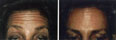
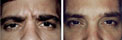
Prominent facial expression lines, especially horizontal lines on the forehead, vertical lines between the eyebrows, and crow's feet are most dramatically improved with treatment.
|
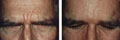
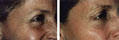
How does Botox® compare to other products such as collagen and filler materials?
Unlike filler materials, Botox® treats the underlying cause of the facial expression lines. Filler materials, such as collagen, only plump up the skin. Although fillers reduce the appearance of lines when there is no facial expression, the moment the person does smile or frown, the lines reappear. Botox® actually prevents the unwanted lines from appearing with facial expression and often even at rest.
How is treatment performed and how many treatments are required?
A small quantity of solution is injected directly into the muscles that are the cause of the prominent furrowing or expression lines. Typically several injections are given with each treatment, and one or two treatments are usually effective in achieving the muscle relaxation required to eliminate the unwanted expression lines.
How long do the results of Botox® last?
The muscle relaxation with Botox® lasts for 3 to 6 months. When the effect of Botox® wears off or diminishes, (i.e., the muscles that contribute to these facial expression lines again become active and the lines gradually reappear) treatment can again be administered.
How does the skin appear after Botox®?
Immediately after treatment the skin appears normal or there may be some redness and swelling at the treated sites. Occasionally, there can be mild bruising. If present, these changes resolve within a few hours to days. The skin feels normal and there is no unusual sensation.
When can I expect to see results after treatment?
Within 48 hours after treatment reduction in the muscle activity can be noticed. About one week after treatment the maximal benefit is attained and continues for a few months.
Are there any limitations after treatment?
No. Immediately after treatment you may resume all normal activities.
Is there any discomfort with treatment?
There is usually mild discomfort at the injection sites. This only lasts for a few seconds.
Are there any risks or side effects?
Rarely. If Botox® should affect an adjacent muscle; it too may have reduced activity. This has been reported in about one percent of those treated and if this does develop, the most common change is eyelid drooping. However, any such unwanted muscle relaxation would also be temporary. There are no reports of any injury to the eye when Botox® is administered to the muscles of the forehead.
Can Botox® cause botulism?
No. Extraordinarily small amounts of Botox® are administered. These quantities are insufficient to cause botulism or any related symptoms.
Take advantage of our ONLINE
CONSULTATION to see if you're a good candidate for Botox® treatment.
It's free and quick.
